How to Verify Canadian Beef Labels: A Step-by-Step Guide

Table of Contents
- Why Verifying Canadian Beef Labels Matters
- Understanding Canadian Beef Grading Standards
- Identifying the Canadian Beef Grading Agency Stamp
- Decoding Federal and Provincial Inspection Marks
- Product of Canada vs Made in Canada Beef
- Reading Packaging Labels for Key Information
- Visual Cues: Marbling and Quality Assessment
- Verifying Beef at the Retail Counter and Beyond
- Frequently Asked Questions
Last Updated: October 4, 2026
Why Verifying Canadian Beef Labels Matters
When you're buying beef for your family, the label tells a story. But most people never learn to read it. They grab a package, glance at the price, and move on. That's where mistakes happen.
At Door To Table, we believe Canadian families deserve to know exactly what they're buying. The truth is simple: understanding how to verify Canadian beef labels gives you control. You stop guessing. You start knowing.
The stakes matter here. Food safety, quality, and supporting local farmers all hinge on one skill: reading what's actually on the package. This guide walks you through every mark, stamp, and designation you'll encounter. By the end, you'll spot the difference between prime and AA grade in seconds.
Let's start with the foundation.
Understanding Canadian Beef Grading Standards
Canadian beef grading standards are the backbone of quality assurance in the meat industry.
Canada uses four main quality grades for beef:
- Prime Grade, The highest quality. Excellent marbling and tenderness. Most tender cuts come here.
- AAA Grade, Superior quality. Good marbling and consistent tenderness. The sweet spot for most home cooks.
- AA Grade, Good quality. Moderate marbling. Still delivers solid flavor and tenderness.
- A Grade, Acceptable quality. Less marbling. Leaner, but still reliable.
Each grade reflects specific marbling standards and meat quality benchmarks. Marbling refers to the white fat lines running through the red muscle. More marbling means more flavor and juiciness when cooked.
The grading process is rigorous. Inspectors examine color, texture, and fat distribution. They follow a sampling plan that ensures every batch meets the standard.
Here's what most people miss: the grade you choose depends on how you'll cook it. Prime and AAA shine when you want tenderness. AA works beautifully for stews and ground beef.
Prime, AAA, AA, and A Grades Explained
Prime Grade is restaurant-quality beef. It has abundant marbling throughout. When you cook it, the fat melts into the meat, creating exceptional tenderness and flavor.
AAA Grade is the most common premium option in Canadian retail. The marbling is excellent without being excessive. It cooks beautifully and delivers consistent results.
AA Grade offers good marbling but less than AAA. It's leaner and works well for people watching fat intake.
A Grade has minimal marbling. It's the leanest option. Use it for slow-cooking methods that add moisture. Stews, braises, and ground beef applications work well here.
The grade designation appears on every package. Look for it near the inspection stamp. It's printed clearly so you can spot it instantly.
Identifying the Canadian Beef Grading Agency Stamp
The Canadian Beef Grading Agency stamp is your proof of quality verification. It's the official mark that tells you a professional inspector has evaluated this beef.
The stamp appears as a purple or blue mark on the package. It includes the grade symbol (Prime, AAA, AA, or A) and often displays a maple leaf.
Not all beef carries this stamp. Some retailers use ungraded beef. That's fine, but you lose the quality guarantee. Graded beef gives you certainty.
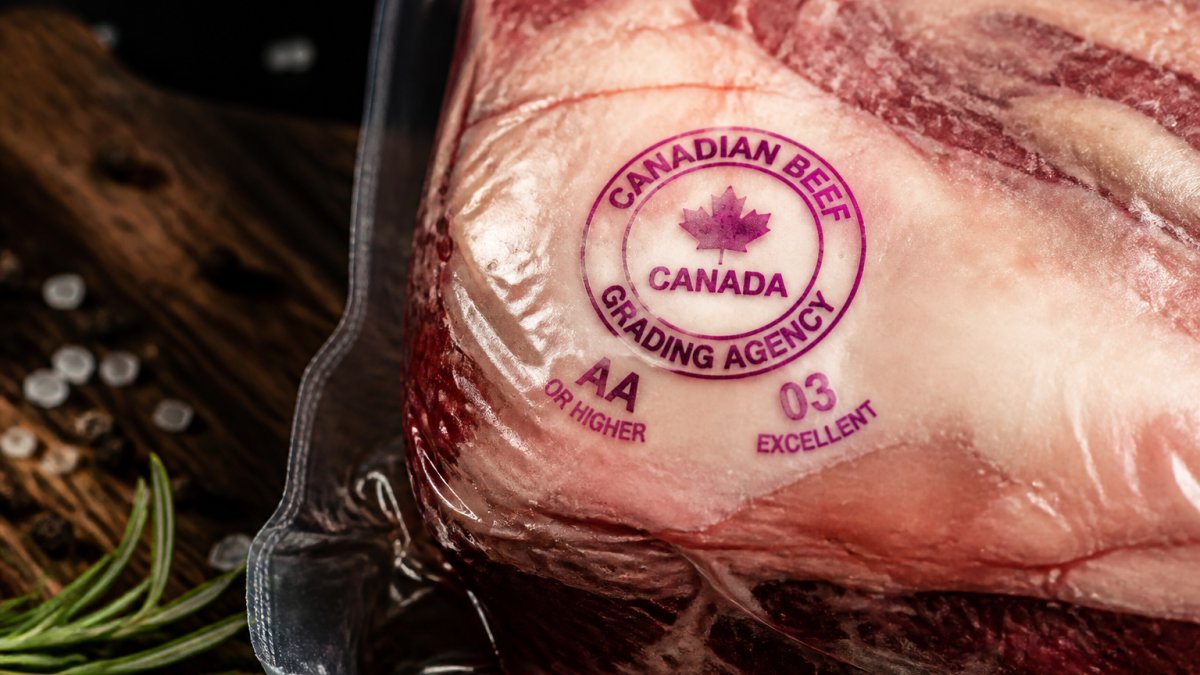
What the Stamp Tells You
The stamp guarantees three things: the beef is safe, it meets quality standards, and it's been inspected by an authorized professional.
When you see the stamp, you know:
- The meat passed food safety inspection
- The marbling and quality meet the stated grade
- The beef is fit for sale in Canada
- A qualified inspector evaluated it personally
The stamp is your assurance. It's the difference between guessing and knowing. When a package lacks this mark, ask your butcher why. Sometimes ungraded beef is perfectly fine. Other times, it means the producer skipped certification.
At Door To Table, every beef product we deliver carries proper grading and inspection documentation.
Decoding Federal and Provincial Inspection Marks
Canadian beef inspection happens at two levels: federal and provincial. Understanding the difference matters.
Federal inspection is the standard across Canada. It's managed under federal food safety legislation. Federally inspected facilities follow strict protocols. They test for pathogens. They maintain detailed records. They're audited regularly.
Provincial inspection is less common but still valid. Some provinces run their own inspection programs. These facilities meet provincial standards, which can vary. Provincial inspection is typically less stringent than federal inspection.
Here's the practical difference: federally inspected beef can be sold across provincial lines. Provincially inspected beef may be restricted to that province only. For consumers, federal inspection offers broader assurance.
The Inspection Stamp and What It Guarantees
The inspection stamp proves the beef passed safety checks. It's usually a circular or rectangular mark. It displays an establishment number and the word "Inspected" or an equivalent phrase.
The stamp guarantees:
- The facility met food safety standards on inspection day
- The meat was handled properly
- Pathogen testing was completed where required
- Documentation is on file with the regulatory authority
When you see the inspection mark, the beef is safe to eat. The stamp is non-negotiable. If a package lacks it, don't buy it.
Look for the establishment number on the stamp. This number identifies the specific facility where the beef was processed. You can verify this number if you want extra assurance. Federal facilities are registered with the Canadian Food Inspection Agency.
Product of Canada vs Made in Canada Beef
These two labels sound similar. They're not. The difference matters when you want to support Canadian ranchers.
Product of Canada means the beef was raised and processed in Canada. The animal spent its entire life here. It was slaughtered and packaged here.
Made in Canada is weaker. It means the beef was processed in Canada, but the animal might have been raised elsewhere.
When you want to support Canadian farmers, look for "Product of Canada." It's the honest label.
Some packages say "Raised in Canada" or "Canadian beef." These terms are less regulated. They might mean the animal was raised here but processed elsewhere.
At Door To Table, our beef is Alberta-raised and processed in Canada.
Reading Packaging Labels for Key Information
The label holds more information than most people realize. Here's what to scan for.
Start at the top. Look for the product name.
Next, find the grade designation. Prime, AAA, AA, or A should appear clearly. If there's no grade, ask why.
Check the weight. It's usually in kilograms. Make sure it matches what you're paying for.
Look for the country of origin statement. "Product of Canada" is what you want if supporting domestic beef matters to you.
Find the inspection mark. It must be present. If it's missing, the beef hasn't been officially inspected.
Scan the expiration or "best before" date. It tells you how long the beef stays fresh.
What to Look for on the Label
The label should include a nutrition facts panel. It shows fat content, protein, and calories per serving. This helps you understand what you're eating.
Ingredients should be simple. Beef is beef. If there are additives, they should be listed. Preservatives, binders, and fillers should be visible.
Storage instructions matter. The label tells you whether to refrigerate or freeze. Follow these instructions. They're based on food safety science.
Some labels include cooking recommendations. These are helpful but optional. They suggest temperature targets and cooking methods.
The barcode connects to the producer's information. Some retailers let you scan it for more details. This transparency is becoming standard.
Common Labeling Terminology Glossary
Understanding beef label language prevents confusion.
Grass-fed, The animal ate grass for most of its life. It may have received grain finishing.
Grain-finished, The animal ate grain in the final weeks before slaughter. This increases marbling and tenderness.
Hormone-free, No added hormones were used.
Antibiotic-free, No antibiotics were administered. This is increasingly common as consumers demand it.
Natural, Minimal processing and no artificial ingredients. This term is regulated but not as strictly as "organic."
Organic, The animal was raised on certified organic feed without synthetic pesticides. The facility meets organic standards.
Pasture-raised, The animal had access to outdoor space. The duration and quality of pasture access vary.
Prime cut, This refers to the meat's position on the carcass, not the grade.
Visual Cues: Marbling and Quality Assessment
You can assess beef quality by looking at it. Marbling is the key visual indicator.
Marbling is the white fat running through the red muscle. More marbling means more flavor and tenderness.
Prime and AAA grades show abundant, visible marbling. The white lines are obvious throughout the cut.
AA grade shows moderate marbling. The white lines are present but less dense.
A grade shows minimal marbling. The meat looks quite red with little white fat visible.
Color matters too. Fresh beef is bright red. Darker red is still fine; it indicates age.
Texture should look smooth and firm. Wet or slimy surfaces indicate bacterial growth. Don't buy it.
The fat cap (the outer layer) should be white or cream-colored.
Verifying Beef at the Retail Counter and Beyond
When you're at the meat counter, you have options. You can inspect the package yourself. You can ask the butcher questions.
Start by examining the package. Look for the grade stamp. Check the inspection mark. Read the label completely.
Ask the butcher where the beef comes from. A good butcher knows their supplier.
Request a specific grade if you have a preference. If they don't stock it, ask when they will.
Inspect the meat itself. Does the marbling match the grade? Is the color right? Does the package look fresh? Trust your eyes.
Check the price. It should align with the grade and cut. Prime costs more than AA. That's normal.
Questions to Ask Your Butcher
Ask where the beef was raised. "Alberta beef" or "Canadian beef" are good answers.
Ask how long the beef has been in the case. Fresh is better.
Ask about the grading process. Did they use the Canadian Beef Grading Agency standard?
Ask about storage. How was it handled before reaching the counter? Proper cold chain maintenance matters.
Ask for recommendations. A good butcher knows their inventory. They can suggest cuts that match your cooking plans.
Ask about custom cuts. Many butchers will trim, portion, or prepare beef to your specifications.
Ask if they can verify sourcing. Some butchers keep supplier documentation.
Knowing how to verify Canadian beef labels transforms your shopping. You move from guessing to understanding.
When you're ready to stop second-guessing grocery store beef, Door To Table delivers restaurant-grade Alberta beef directly to your door in Edmonton and surrounding areas and Ft. Every cut is graded, inspected, and sourced from Canadian ranchers. Flash-frozen at peak freshness, it arrives in portion-controlled packages. Just the confidence that every meal you serve meets your standards for quality and safety. Shop with us and see the difference verified Canadian beef makes.
Frequently Asked Questions
What is the difference between Canada AA and AAA beef?
AAA beef has superior marbling and tenderness compared to AA grade. AAA beef contains more intramuscular fat, which enhances flavor and juiciness. AA beef is still high quality but has less marbling. Both meet strict Canadian beef grading standards and are safe, inspected products. The choice depends on your preference for tenderness and flavor intensity; AAA commands a premium price for its superior quality.
How do I identify the Canadian Beef Grading Agency stamp on packaging?
The Canadian Beef Grading Agency stamp appears as a branded mark on the package and indicates the beef has been officially graded. The stamp displays the grade designation (Prime, AAA, AA, or A). Look for this mark near the product information on the front or back of the package. It's your assurance that the beef has undergone quality assessment by certified graders following federal standards.
What does 'Product of Canada' mean for beef?
'Product of Canada' means the beef was raised, processed, and packaged entirely in Canada. This designation ensures compliance with Canadian food safety regulations and traceability standards. It differs from 'Made in Canada,' which may include imported beef that is processed domestically. For consumers prioritizing Canadian sourcing, 'Product of Canada' provides the strongest assurance of domestic origin.
What labeling information is required on Canadian beef packages?
Canadian beef packages must display the product name, net weight, grade designation, country of origin, safe handling instructions, and the establishment number of the federally inspected facility. The inspection stamp confirms the product passed food safety checks under the Safe Food for Canadians Regulations. Additional information may include cut type, best-before date, and storage instructions to guide proper handling and preparation.


