Benefits of Flash Frozen Meat: A Guide
Table of Contents
- What Is Flash Freezing and How Does It Work?
- Nutrient Retention: Why Flash Frozen Meat Keeps Its Nutritional Value
- Flash Frozen vs Fresh Meat: What Actually Matters
- Food Safety and Microbial Control in Flash Frozen Proteins
- Texture and Quality Preservation: Preventing Ice Crystal Damage
- How to Thaw Frozen Steak and Other Flash Frozen Cuts Safely
- Safe Meat Thawing Methods: Best Practices for Your Kitchen
- Convenience and Lifestyle: Why Busy Families Choose Flash Frozen
- Frequently Asked Questions
Last Updated: September 27, 2026
What Is Flash Freezing and How Does It Work?
Flash freezing is a rapid cooling process that drops food to ultra-low temperatures in minutes, not hours. It locks in freshness by preventing large ice crystals from forming inside the meat's cellular structure. (Source: studies on nutrient retention in frozen foods)
Here's how it works: meat is exposed to temperatures well below standard freezer settings. This speed matters because slow freezing allows water inside the cells to expand and rupture the tissue. Flash freezing happens so fast that water freezes before it can escape, preserving the meat's original texture and moisture.
The result is meat that thaws closer to fresh than anything you'd find in a grocery store freezer. When Door To Table flash freezes Alberta beef and wild-caught seafood at peak freshness, you're getting protein locked in time.
Nutrient Retention: Why Flash Frozen Meat Keeps Its Nutritional Value
Nutrients don't survive slow freezing well. When ice crystals form slowly inside meat cells, they rupture the cell walls and cause nutrient leakage. Vitamins like B12, folate, and niacin are water-soluble and escape into the liquid that drains from thawed meat. Minerals like iron and zinc are bound to proteins; when those proteins denature from ice crystal damage, mineral bioavailability decreases. Flash freezing changes this entirely.
When meat freezes in minutes rather than hours, the cellular structure stays intact. Water freezes in place before it can migrate out of cells, so the cell membrane remains unbroken. This preservation of cellular architecture means:
- B vitamins (B12, B6, niacin, pantothenic acid) remain stable inside intact cells and don't leach into drip loss during thawing
- Minerals (iron, zinc, selenium, phosphorus) stay bound to their protein matrices, maintaining their absorption efficiency in your digestive system
- Protein structure doesn't denature, so amino acid profiles remain complete and bioavailable
- Fat-soluble vitamins (A, D, E, K) are protected from oxidative breakdown because rapid freezing minimizes the time meat spends in the temperature zone where oxidation accelerates
This matters for your family's health in concrete ways. Fresh meat sitting in a refrigerator for 3-5 days loses measurable nutrient value. Studies on refrigerated beef show B12 retention drops by 10-15% over a week. Vitamin C in fresh poultry can degrade by 20% or more in the same timeframe. Flash frozen meat locked in at peak freshness, within hours of butchering, holds its full nutrient profile for months. When you thaw it properly and cook it, you're consuming meat with nutrient density closer to the day it was harvested than to grocery store "fresh" that's been aging for days.
The practical benefit: you're not sacrificing nutrition for convenience. You're getting both, and often better nutrition than fresh meat that's been sitting under retail lighting and temperature fluctuation.
Flash Frozen vs Fresh Meat: What Actually Matters
Most people assume fresh is always better. The data tells a different story.
Fresh meat from a grocery store has already lost days to transport and shelf time. Oxidation has started breaking down fats. Enzymatic breakdown has begun degrading texture. By the time you cook it, "fresh" might actually be older than flash frozen meat from the day it was caught or butchered.
Flash frozen meat, by contrast, stops time. If it was frozen within hours of harvest, it's genuinely fresher than grocery store meat that's been sitting for a week.
The real difference comes down to this: fresh meat is fresher only if you cook it the same day you buy it. Flash frozen meat is fresher if you freeze it immediately after harvest. Door To Table flash freezes Alberta beef and Canadian seafood at peak quality, so you're comparing day-one freshness against week-old grocery store stock.
For texture, taste, and food safety, flash frozen wins most comparisons.
Food Safety and Microbial Control in Flash Frozen Proteins
Freezing stops microbial activity cold. Bacteria don't multiply in frozen conditions. This is why flash frozen meat is one of the safest protein options available.
The speed of flash freezing adds another safety layer.
Texture and Quality Preservation: Preventing Ice Crystal Damage
Ice crystal formation is the enemy of texture. Large crystals puncture cell walls, causing drip loss when the meat thaws. You end up with mushy, dry protein.
How to Thaw Frozen Steak and Other Flash Frozen Cuts Safely
Thawing is where most people lose the quality advantage they paid for when they bought flash frozen meat. The thawing method determines whether you keep all that cellular integrity and nutrient value locked in during freezing, or whether you let bacteria multiply and ice crystal damage undo the work. (Source: Food and Drug Regulations)
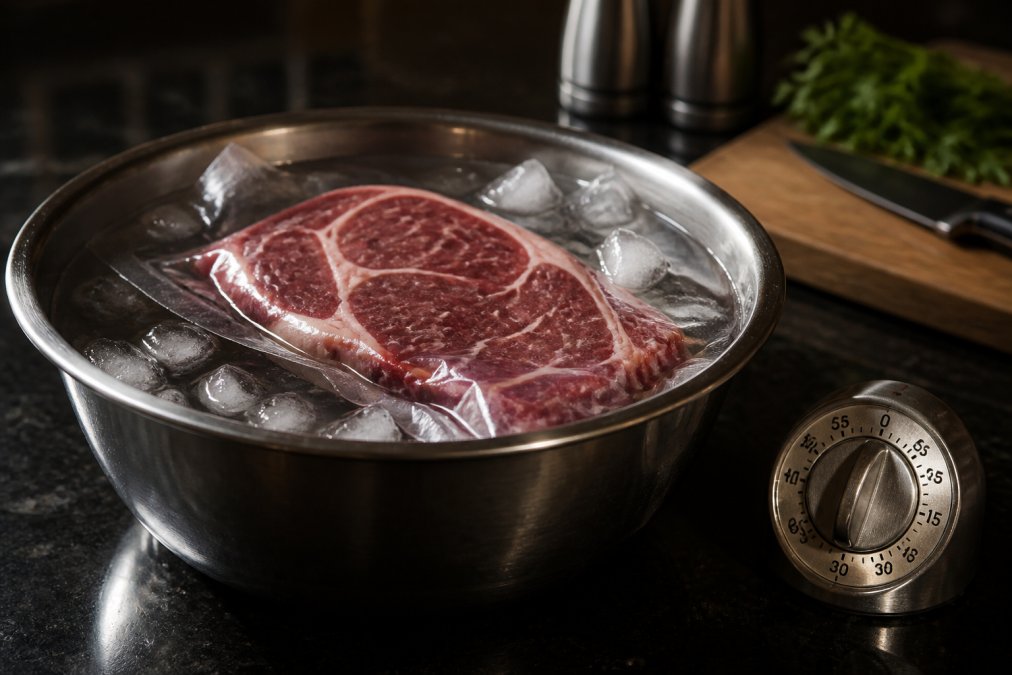
Refrigerator thawing (best method): Move your steak, chicken, or roast to the fridge 24 hours before cooking. It thaws slowly and evenly while staying below 4°C the entire time. Bacteria remains dormant. This method takes planning but delivers the best results because:
- The meat never enters the danger zone
- Thawing is even, so the surface and center reach safe temperatures at the same rate
- Drip loss is minimal, so you retain more of the meat's moisture and nutrients
- Thawed meat stays safe in the fridge for an additional 1-2 days before cooking, giving you flexibility
Cold water thawing (fastest safe method): When you need speed, seal the meat in a waterproof bag and submerge it in cold water. Change the water every 30 minutes to maintain the cold temperature. A 2 cm steak thaws in 1-2 hours; a 1.5 kg roast in 4-6 hours. This method works because:
- Water conducts heat faster than air, so thawing is quicker than the fridge method
- The meat stays cold (below 4°C) as long as you change the water regularly
- The sealed bag prevents cross-contamination
- You can cook immediately after thawing with no additional safety delay
Never do this:
- Leave meat on the counter at room temperature (bacteria multiplies rapidly)
- Use warm or hot water (accelerates bacterial growth)
- Thaw in direct sunlight or near a heat source
- Refreeze meat after thawing unless you've cooked it first
Safe Meat Thawing Methods: Best Practices for Your Kitchen
Thawing safely means keeping meat cold and preventing cross-contamination. Here's what actually works:
Refrigerator method:
- Move meat to fridge 24 hours before cooking
- Keep it on the bottom shelf so drips don't contaminate other food
- Thawed meat stays safe in the fridge for 1-2 days before cooking
Cold water method:
- Seal meat in a waterproof bag
- Submerge in cold water
- Change water every 30 minutes
- Cook immediately after thawing
Never do this:
- Leave meat on the counter
- Use warm water
- Thaw in direct sunlight
- Refreeze without cooking first
| Thawing Method | Time Required | Safety Zone | Best For |
|---|---|---|---|
| Refrigerator | 24 hours | Stays cold entire time | Steaks, roasts, planning ahead |
| Cold water | 1-2 hours | Stays cold with water changes | Quick meals, smaller cuts |
| Microwave | 10-30 minutes | Can create warm spots | Emergency only, cook immediately |
Convenience and Lifestyle: Why Busy Families Choose Flash Frozen
Flash frozen meat solves a real problem: you can't always shop fresh, but you want fresh quality.
Frequently Asked Questions
Is flash-frozen meat better than fresh meat?
Flash frozen meat and fresh meat each have advantages. Flash frozen meat is frozen at peak ripeness, locking in nutrients, tenderness, and flavor through ultra-low temperature processing that minimizes ice crystal formation. Fresh meat offers no added processing, but quality depends on time in the supply chain. For home cooks, flash frozen meat delivers consistent restaurant-grade results without the guesswork of grocery store selection, making it ideal for families prioritizing convenience and food safety.
How do I properly thaw flash-frozen steak for the best texture?
Thaw flash-frozen steak in the refrigerator overnight (8-12 hours) or use the cold water method: seal the steak in a bag and submerge it in cold water for 30-60 minutes, changing the water every 15 minutes. Never use hot water, as rapid thawing damages cellular structure and causes drip loss. Refrigerator thawing is preferred because it maintains protein integrity and texture. Once thawed, cook within 24 hours for best results.
Does flash freezing affect the nutritional value of meat?
Flash freezing preserves nutritional value better than conventional freezing. The ultra-low temperatures halt enzymatic breakdown and oxidation, protecting vitamins, minerals, and protein integrity. Studies show flash frozen meat retains nearly the same nutrient profile as fresh meat at the moment of freezing. Since flash frozen products are frozen at peak freshness, they often contain more nutrients than fresh meat that has spent days in transit or on store shelves.
How long can you keep flash-frozen meat in the freezer?
Flash frozen meat maintains quality for 12-18 months in a standard home freezer when stored properly in airtight, moisture-barrier packaging. The ultra-low initial freezing temperature and quality packaging films prevent freezer burn and oxidation far longer than conventionally frozen meat. For best flavor and texture, use within 12 months. Always store at -18°C or colder and keep packaging intact to maintain barrier properties against moisture loss and air exposure.
Flash frozen meat delivers something grocery stores can't: peak freshness preserved. Door To Table brings that quality to your door with Alberta beef, free-range chicken, and wild-caught Canadian seafood flash frozen at harvest. Every portion is inspected, portion-controlled, and ready to thaw and cook. Shop Door To Table and get restaurant-grade protein your family deserves.


