Best Online Meat Delivery Canada: 2026 Buyer's Guide
Table of Contents
- What to Look For in Online Meat Delivery
- Comparing Meat Quality and Cut Variety Across Providers
- How to Store Delivered Frozen Meat Safely
- The Benefits of Free-Range Chicken and Grass-Fed Beef
- Meat Subscription Box Edmonton: What Local Buyers Should Know
- Cost, Convenience, and Sustainability: The Full Picture
- Conclusion
- Frequently Asked Questions
Last Updated: September 15, 2026
What to Look For in Online Meat Delivery
The best online meat delivery services get three things right: traceable sourcing, an unbroken cold chain, and honest labeling. Everything else, from box design to loyalty perks, is secondary. This buyer's guide from Door To Table walks through what actually separates a reliable online meat delivery service from one that leaves you guessing.
Start with the label. "Grass-fed," "free-range," and "hormone-free" are meaningful only when the producer can show you where the animal was raised and how it was handled. If a provider won't tell you the farm, the region, or the inspection standard behind a cut, treat that silence as your answer.
Traceability and Canadian Sourcing
Traceability means you can follow a cut from farm to freezer. A serious provider names the ranch, the region, and the facility where the meat was processed. Door To Table sources 95% of its products from Canada, including Alberta-raised beef, free-range chicken, and wild-caught seafood, and every item moves through government-inspected facilities. That paper trail is the difference between a marketing claim and a verifiable one.
Cold Chain Logistics and Freshness Guarantees
The cold chain is the unbroken stretch of freezing and refrigeration that keeps meat safe from the processor to your door. A break anywhere in that chain, even a few hours in a warm truck, shortens shelf life and compromises texture. Flash-freezing at peak freshness locks in quality before ice crystals can damage muscle fibers, and a freshness guarantee should spell out exactly what happens if your order arrives compromised.
Comparing Meat Quality and Cut Variety Across Providers
Quality shows up in the details: marbling, cut depth, and whether the provider offers the specific cuts your household actually cooks. A box full of unfamiliar specialty cuts sounds impressive until it sits in your freezer for eight months.
Reading Quality Signals Like a Butcher
Marbling, the fine white flecks of intramuscular fat, is the single best visual predictor of flavor and tenderness in beef. A well-marbled ribeye or striploin will show fat distributed evenly through the muscle, not just a thick fat cap on the edge. For poultry, look at the color and texture of the raw breast: pale, uniform flesh with no bruising or excess water in the vacuum seal is a sign the bird was handled well. For pork, a rosy pink color and a firm, slightly damp surface indicate fresh product rather than meat that has been refrozen after a cold-chain break.
Cut terminology matters too. 'Ribeye,' 'striploin,' 'tenderloin,' and 'sirloin' are specific primal cuts with predictable texture and cooking methods. A provider that lists cuts by name, rather than 'premium steak assortment', is telling you it knows its supply chain. If the description is vague, the cut you receive may be a trim or end piece rather than a center-cut portion.
Matching Cuts to How You Actually Cook
Variety matters just as much as quality. A family that grills weekly needs steaks, ground beef, and chicken breasts in consistent portions. A home cook building weeknight meals wants portion-controlled servings that thaw fast and fit a standard pan. Look for protein variety across beef, poultry, pork, and seafood rather than a single-species box, and check whether you can customize the box or filter by dietary preference.
Dietary-Specific Filtering: The Question Most Providers Don't Answer
This is where most comparison tables stop, and it's the gap worth claiming. Health-conscious buyers increasingly search by diet, not by protein. If you follow keto, paleo, or an autoimmune protocol (AIP), you need to know whether a box contains grain-finished beef (common in standard bundles) or grass-finished beef, whether sausages contain fillers or added sugars, and whether ground meat is lean or regular. If you follow halal or kosher dietary rules, you need a provider that can confirm the slaughter and handling standard, not just a 'premium' label.
A practical filter checklist before you subscribe:
- Keto / low-carb: prioritize grass-finished beef, plain ground meat, and sausages without breadcrumbs or sugar.
- Paleo / AIP: avoid processed deli meats and anything with nitrates, nightshade-based seasonings, or seed oils.
- Halal: confirm the slaughter standard and ask whether the facility is certified; a named certification is the only reliable answer.
- High-protein / portion control: look for individually vacuum-sealed 150-200 g servings so you can hit a protein target without guessing.
If a provider can't answer these questions in writing, that's your answer. The best services publish a cut list, a protein-per-portion figure, and a clear statement of what's in their seasoned or processed items.
| What to Compare | Why It Matters | What to Look For |
|---|---|---|
| Sourcing transparency | Tells you if claims are real | Named farms, region, inspection standard |
| Marbling and cut naming | Predicts flavor and tenderness | Specific primal cuts, visible intramuscular fat |
| Cut variety | Prevents freezer fatigue | Beef, poultry, pork, seafood options |
| Portion control | Reduces waste | Individual vacuum-sealed servings (150-200 g) |
| Dietary filtering | Fits medical or ethical needs | Keto, paleo, AIP, halal options stated in writing |
| Customization | Fits your household | Swap or filter by preference |
| Freshness guarantee | Protects your money | Clear replacement policy |
How to Store Delivered Frozen Meat Safely
Frozen meat stays safe indefinitely when held at -18°C or below, but quality fades over months, so label and rotate your stock (Safe food storage). Move deliveries straight to the freezer within an hour of arrival, and keep a thermometer on the shelf to confirm the temperature holds.
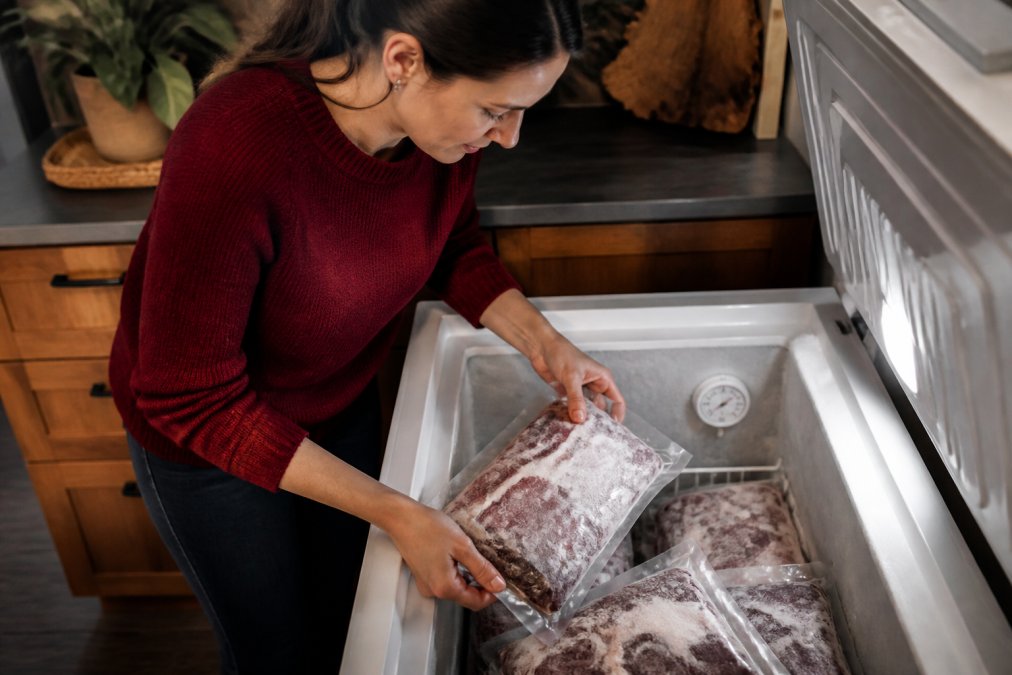
Vacuum-sealed packaging is your ally here. It blocks freezer burn, which is the dry, grayish patch that forms when air reaches the surface of the meat. Keep packages flat and stacked so you can see what you have, and use the oldest cuts first. A simple marker on the package with the delivery date saves you from mystery meat six months down the line.
Thawing Without Compromising Quality
Thaw meat in the refrigerator, never on the counter (Safely defrosting foods). A full day in the fridge for larger cuts, and a sealed bag submerged in cold water for a faster thaw, both keep the meat in the safe temperature zone. Cook thawed meat within a couple of days, and never refreeze it once it has fully thawed.
The Benefits of Free-Range Chicken and Grass-Fed Beef
Free-range chicken and grass-fed beef earn their reputation for reasons you can taste and measure. Free-range birds move freely, which builds denser muscle and a firmer texture than conventionally raised poultry. Grass-fed beef tends to carry less total fat and a different fat profile than grain-finished beef, and many home cooks find the flavor cleaner and more pronounced.
The benefits of free-range chicken go beyond the plate. Free-range and pasture-raised systems generally place a higher priority on animal welfare standards, and producers who invest in those standards usually invest in traceability too. That combination is what lets you serve a meal with confidence rather than crossing your fingers.
For families trying to cut back on processed food, these proteins do a lot of the work. A plain chicken breast or a grass-fed steak needs salt, heat, and little else. Door To Table built its catalog around that idea: restaurant-grade protein, portion-controlled, flash-frozen at peak freshness, with no guesswork in the grocery aisle.
Meat Subscription Box Edmonton: What Local Buyers Should Know
A meat subscription box in Edmonton works best when the delivery radius actually covers your address. Door To Table focuses on Edmonton, the surrounding areas, and Fort McMurray, so buyers in those zones get reliable doorstep delivery.
Subscription frequency is the other piece. A household of two and a family of five should not be locked into the same cadence.
Cost, Convenience, and Sustainability: The Full Picture
A Price-Per-Pound Framework You Can Actually Use
A practical way to compare:
Convenience Without the Discipline Myth
Sustainability: What to Actually Ask
Three questions separate real sustainability claims from marketing:
The Bottom Line on Cost
Conclusion
Frequently Asked Questions
What is the highest rated meat delivery service in Canada?
Ratings vary by region and diet, so check recent customer reviews and whether the provider publishes its sourcing and inspection standards. Look for a service that is government inspected, offers a freshness guarantee, and lets you customize cuts and frequency. Door To Table, for example, holds a 4.9/5 rating from thousands of customers and sources 95% of its products from Canada.
Is flash-frozen meat as fresh as fresh-cut meat?
Flash-frozen meat is often fresher than grocery store 'fresh' cuts because it is frozen at peak freshness shortly after processing. The fast freeze limits ice crystal formation, which protects texture and moisture. As long as the cold chain stays unbroken from the facility to your door, quality holds up well. Check that packaging is vacuum-sealed and still frozen solid on arrival.
How do I know the meat is actually from Canadian farmers?
Ask for traceability details: which farms or ranches supply the meat, where it was processed, and whether the facility is government inspected. Reputable providers list this information or will share it on request. Door To Table, for instance, sources Alberta-raised beef, free-range chicken, and 95% Canadian seafood, and can confirm provenance for customers who ask.
How does portion-controlled meat delivery reduce food waste?
Portion-controlled packaging means you thaw only what you need for a meal, so nothing sits in the fridge and spoils. Smaller households especially benefit, since larger grocery packs often go unused. If your family is small, choose a provider that offers flexible box sizes and adjustable delivery frequency so you are not stuck with more meat than your freezer can hold.


