7 Tips for Small Family Meals That Save Time and Money

Last Updated: October 29, 2026
Quick Summary
Small family meals work best when you plan four to five dinners instead of fourteen, cook two or three meals' worth at a time, and portion by eater rather than by recipe. A household of two adults and one child needs about three and a half portions per dinner, not six.
- Plan four or five cooking nights and repeat a base ingredient twice to cover more dinners.
- Keep batch cooking to two or three meals' worth so prepped food does not spoil.
- Portion onto plates in the kitchen instead of serving family-style to control amounts.
- Build dinners from a base, protein, vegetable, and sauce so each eater assembles their own plate.
- Cool cooked food within two hours, refrigerate in shallow containers, and label with the date.
Table of Contents
- Why Small Family Meals Need a Different Approach
- Small Family Meal Planning That Fits Your Week
- Family Meal Prep: Batch Cooking Without the Waste
- Portion Control for Family Meals: How Much to Cook
- Easy Family Dinners With Shortcut Ingredients
- Handling Allergies, Picky Eaters, and Different Appetites
- Food Safety and Storage for Batch-Prepped Meals
- Reducing Food Waste Through Leftovers
- Frequently Asked Questions
Why Small Family Meals Need a Different Approach
Cooking for two or three people is not just cooking for a crowd, scaled down. The math works against you. A family-sized pack of chicken thighs, a whole head of lettuce, a big pot of chili: all of it was sized for four to six eaters, and leftovers pile up faster than small households can eat them.
That mismatch is where most food waste starts. It's also where weeknight stress starts. Many parents say the same thing: dinner feels harder than it should, and the fridge is full of half-used ingredients going soft.
Small family meals need their own playbook. If you're also trying to keep the meat budget in check, our guide on how to save on meat pairs well with everything below.
Small Family Meal Planning That Fits Your Week
Meal planning is deciding what you'll cook before the week starts, so dinner isn't a daily scramble. A Dinner is Done Box takes the guesswork out of the protein side of the plan. For a small household, the goal is simple: plan four to five dinners, not fourteen.
Here's a routine that works:
- Pick your cooking nights. Most small families cook four or five evenings and leave the rest flexible.
- Choose one protein per night. Chicken, beef, fish, pork, or a meatless option.
- Repeat a base ingredient twice. If you cook chicken on Monday, use the rest in wraps on Thursday.
- Write your shopping list from the plan, not from memory.
- Post the schedule where everyone can see it.
Build a Simple Weekly Meal Schedule
A realistic small-family week might look like this:
| Night | Dinner | Why It Works |
|---|---|---|
| Monday | Sheet-pan chicken and vegetables | One pan, easy cleanup |
| Tuesday | Beef tacos | Kids assemble their own |
| Wednesday | Leftover chicken wraps | Uses Monday's extras |
| Thursday | Salmon with rice and frozen veg | Fast and balanced |
| Friday | Homemade pizza or pasta | Fun end to the week |
That's five dinners from four cooking sessions. Planning ahead like this saves time and cuts the "what's for dinner" stress that wears families down.
Family Meal Prep: Batch Cooking Without the Waste
Family meal prep means cooking components ahead of time and storing them so weeknights run faster. The trick for small households is batch cooking in small batches.
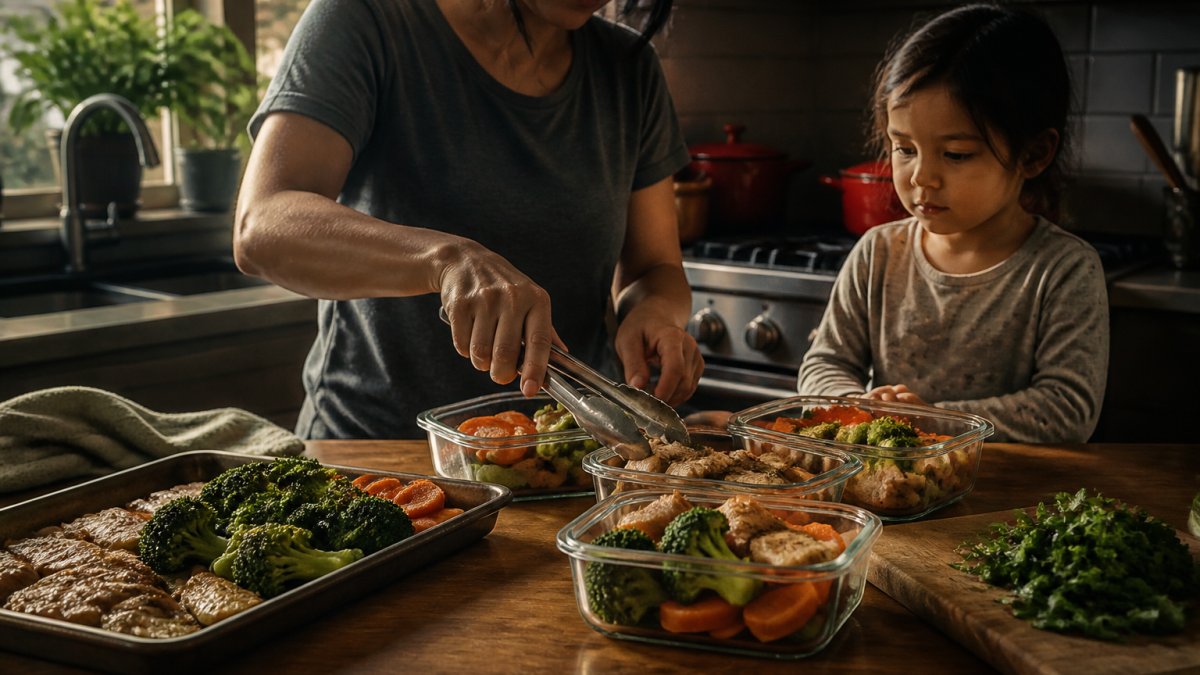
A common mistake is prepping full recipes instead of parts. Cooked rice, roasted vegetables, and grilled protein can become tacos, bowls, or stir-fries depending on the night. Cook once, eat three ways.
The Assembly-Line Method for Small Batches
Set up your prep like a short line:
- Station 1: Cook and cool the protein.
- Station 2: Chop vegetables into meal-sized portions.
- Station 3: Portion everything into containers labeled with the day you'll eat it.
A 45-minute Sunday session covers most of the week. Keep batches to two or three meals' worth, not seven.
Portion Control for Family Meals: How Much to Cook
Portion control is matching how much you cook to how much your household actually eats, so nothing gets scraped into the bin. For a small family, the goal is not to cook less food, it is to cook the right amount once, with a deliberate extra portion for tomorrow's lunch.
A workable starting framework, based on common dietitian guidance rather than a single recipe card:
- Protein: one palm-sized piece per adult (roughly 100-150 g cooked), a half-palm per child under 10, and one extra portion set aside for lunch.
- Starch: about one cupped handful of cooked rice, pasta, or potato per adult, half that for young children.
- Vegetables: fill half the plate, vegetables are the cheapest way to make a meal feel generous without overshooting on the expensive components.
That framework scales cleanly. A household of two adults and one child cooks roughly two and a half adult portions per meal, plus one lunch portion, about three and a half portions total.
Scaling by Age Without Overbuying
Appetites change week to week, so treat these as anchors, not rules:
| Eater | Protein per meal | Starch per meal | Vegetables |
|---|---|---|---|
| Adult | 100-150 g cooked | 1 cupped handful | Half the plate |
| Child 6-12 | 50-75 g cooked | Half a handful | A few tablespoons, offered twice |
| Child under 6 | 30-50 g cooked | A few tablespoons | One tablespoon to start |
| Teen | 150-200 g cooked | 1-2 handfuls | Half the plate |
Two practical habits close the gap between the framework and real life. First, portion onto plates in the kitchen rather than serving family-style from the table, it is easier to see how much is actually being eaten, and it stops the "just one more scoop" cycle that leaves no leftovers for lunch. Second, keep a small digital scale or a set of measuring cups on the counter for the first week or two; after that, most cooks can eyeball a palm or a handful accurately enough.
Portion-controlled cuts can take much of the guesswork out of cooking for a small household. (Source: Health Canada's Food Guide)
Easy Family Dinners With Shortcut Ingredients
Shortcut ingredients are pre-prepped items that cut cooking time without cutting quality: pre-cut vegetables, frozen rice, jarred sauces, and portioned proteins. They're not cheating. They're how busy families get a real dinner on the table on a Tuesday.
Stock these staples:
- Frozen vegetables and frozen rice
- Pre-washed salad greens
- Canned tomatoes and beans
With those on hand, a balanced dinner takes about 20 minutes.
Handling Allergies, Picky Eaters, and Different Appetites
Different eaters at one table is normal, not a problem to solve once. One child avoids dairy, another won't touch anything green, and your partner eats twice what you do. The fix is a flexible base meal with mix-ins on the side, a template you can repeat across dozens of dinners rather than a new recipe every night.
The Base-Plus-Mix-Ins Template
Build every dinner from four slots, then let each eater assemble their own plate:
- Base: rice, pasta, tortilla, potato, or salad greens.
- Protein: chicken, beef, fish, eggs, beans, or tofu, cooked plain, seasoned on the side.
- Vegetable: one cooked and one raw option, both served separately.
- Sauce or topping: cheese, yogurt, salsa, pesto, or dressing in small bowls.
A taco night, a rice bowl, a pasta bar, and a baked-potato night are all the same template wearing different clothes. The base meal is cooked once; the variation happens at the table, not at the stove.
Substitutions That Actually Work
Keep a short substitution map taped inside a cupboard door so you are not reinventing it at 6 p.m.:
- Dairy-free: swap cheese for avocado or a dairy-free shred; swap yogurt for mashed avocado or a dairy-free spread; swap butter for olive oil.
- Gluten-free: swap wheat pasta for rice or corn pasta; swap tortillas for corn tortillas or lettuce cups; swap breadcrumbs for crushed cornflakes.
- Egg-free: swap egg wash for milk or oil; swap binder eggs in meatballs for a tablespoon of ground flax mixed with water.
- Nut-free: swap pesto for a seed-based pesto or a tomato sauce; check labels on jarred sauces, which are a common hidden source.
For allergies specifically, the practical rule is cross-contact control, not just ingredient swaps. Use separate utensils and a separate small pan or foil packet for the allergen-free portion, and read labels every time, manufacturers change formulations without notice (Before you shop: food allergies and allergen labelling). When in doubt, serve the allergen-containing component on the side rather than mixed in.
Picky Eaters Without Short-Order Cooking
- Serve sauces and toppings separately so each eater controls flavor.
- Keep one "safe" food on every plate, a food the child reliably eats.
- Let kids choose their own portion from what's offered, and let them serve themselves once they are old enough.
- Offer a new food next to a familiar one, without pressure and without a reward attached.
A final note on different appetites: serve the same food to everyone and let portion size vary. A child who eats half a portion tonight may eat one and a half tomorrow, the template holds either way, and you are not cooking twice.
Food Safety and Storage for Batch-Prepped Meals
Safe storage is what makes meal prep worth the effort. Cool cooked food within two hours of cooking, refrigerate in shallow containers, and eat refrigerated leftovers within a few days.
For frozen portions, thawing in the fridge is the safest approach (Safely defrosting foods).
Watch out: reheating the same container of food more than once is a common prep mistake. Portion into single-meal containers so you only reheat what you'll eat.
Reducing Food Waste Through Leftovers
Leftovers are only waste when nobody plans to eat them. Give them a job before they hit the fridge: Monday's roast chicken becomes Wednesday's soup, and Sunday's rice becomes Friday's fried rice.
A few habits that help:
- Designate one "clean out the fridge" dinner each week.
- Freeze extra portions the same night you cook them.
- Keep leftovers at eye level so they get seen.
Small households that plan leftovers as meals rather than accidents tend to throw out less food.
Frequently Asked Questions
How do you plan meals for a small family?
Start with a short weekly meal schedule of three to five dinners, then build one shopping list around those meals. For a household of two or three, plan for fewer meals than you think you need and leave one night open for leftovers. Group recipes that share ingredients, like a chicken dish and a stir-fry, so nothing sits unused in the fridge. A written plan on the fridge door also stops the last-minute takeout decision on busy weeknights.
How much meat should you plan per person for a family meal?
A common guideline is about 150 to 200 grams of raw boneless meat per adult per meal, with smaller amounts for children depending on age and appetite. For a family of three, that means roughly 450 to 600 grams of protein for dinner. Portion-controlled cuts make this easier because you can pull exactly what you need from the freezer instead of thawing a family-sized pack and hoping the rest gets used.
How can a small family reduce food waste?
Cook smaller batches, store leftovers in clear containers you can see, and plan one leftover night each week. Freeze extra portions the same day you cook them rather than letting them sit in the fridge. Buying portion-controlled protein helps too, since you thaw only what you will cook. A quick fridge check before you shop also stops you from buying a second jar of something you already have.
What are easy family dinners for a small household?
One-pot meals, sheet-pan dinners, and simple pasta or rice bowls work well because they scale down easily and create fewer dishes. Keep staple ingredients on hand, like canned tomatoes, rice, frozen vegetables, and portioned chicken or beef, so you can assemble dinner without a full grocery run. Shortcut ingredients such as pre-cut vegetables or jarred sauce save time without adding much cost.
Small family meals work best when the portions fit the people eating them, and that starts with the protein you bring home. Door To Table delivers flash-frozen, portion-controlled Alberta beef, free-range chicken, and wild-caught seafood, all from government-inspected facilities and ready for the freezer. Get started with Door To Table and make weeknight dinners simpler, one box at a time.


