Why Support Canadian Farmers: 7 Reasons That Matter
Table of Contents
- Why Support Canadian Farmers Matters to Your Family
- Canadian Agriculture and Food Security: The Foundation of What We Eat
- How to Support Local Farmers: Practical Actions You Can Take
- Benefits of Buying Local Food: Economic Impact and Community Strength
- Buying Canadian Meat: How to Identify and Choose Domestic Proteins
- The Real Challenges Farmers Face Today
- Your Role in Sustaining Canadian Agriculture
- Frequently Asked Questions
Last Updated: October 12, 2026
Why Support Canadian Farmers Matters to Your Family
When you choose to support Canadian farmers, you're making a decision that ripples far beyond your dinner table. Food security, rural livelihoods, and the strength of domestic agriculture all depend on the choices families make every single day. At Door To Table, we've built our entire business around this principle: connecting families with the producers who grow, raise, and catch the food that nourishes them.
The question isn't really whether you can afford to support Canadian farmers. It's whether you can afford not to.
Canadian agriculture feeds your family while supporting rural communities, sustaining jobs, and building resilience into our food system. When you buy Canadian, you're investing in people and practices that matter. Here are seven reasons why supporting Canadian farmers deserves a place in your family's food choices.
Canadian Agriculture and Food Security: The Foundation of What We Eat
Food security means having reliable access to safe, nutritious food year-round. That foundation depends entirely on domestic producers who understand local growing conditions, weather patterns, and the unique demands of feeding a nation. When Canadian farmers thrive, your family's access to fresh, traceable food strengthens.
Consider what happens when food supply chains break. Global disruptions, weather events, trade disputes, transportation delays, suddenly make imported food scarce or expensive. Domestic agriculture acts as a buffer. Farmers across the country produce beef, chicken, seafood, and vegetables that don't depend on distant supply chains or border crossings.
This isn't just theory. Families who prioritize Canadian-sourced proteins report greater confidence in what they're serving. They know the story behind their food. They know it came from a producer committed to Canadian standards, not a distant facility they've never seen.
When you support Canadian farmers, you're building a food system that can feed your family reliably, regardless of what happens globally. That's food security in its most practical form.
How to Support Local Farmers: Practical Actions You Can Take
Supporting farmers doesn't require overhauling your entire shopping routine. Small, deliberate choices add up quickly.
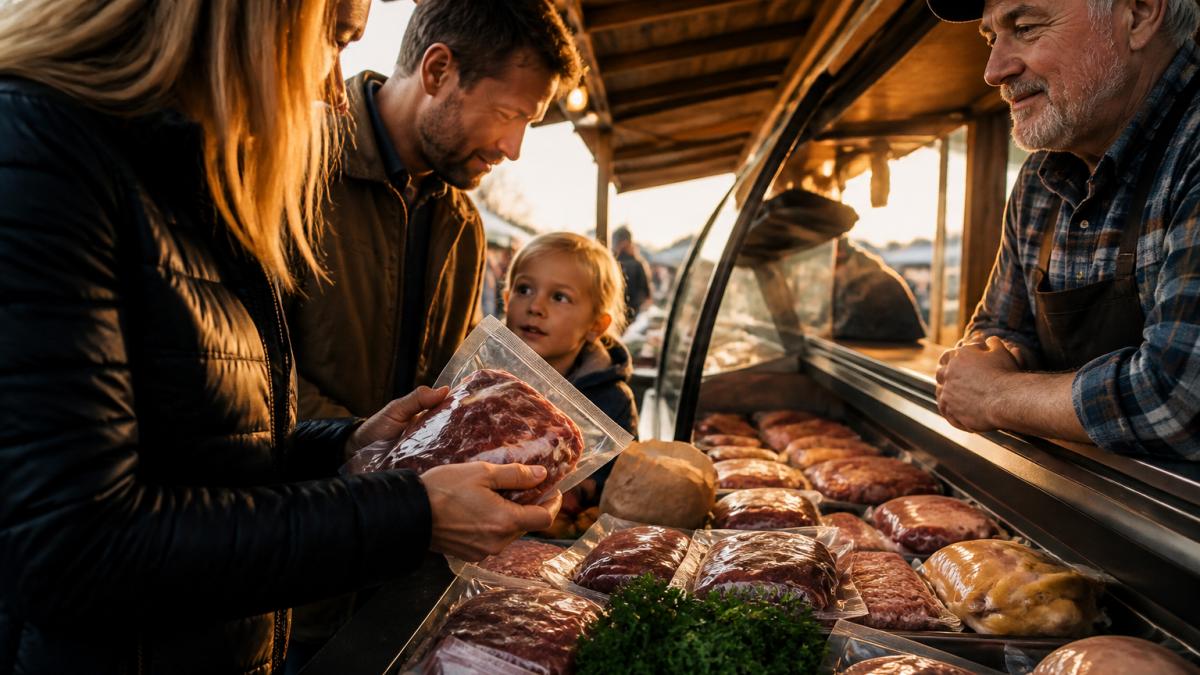
Buy directly when possible. Farmers markets, farm stands, and direct-to-consumer services like Door To Table cut out the middlemen. More of your money reaches the producer. You also get to ask questions: How was this raised? When was it harvested? What's your farming practice? Direct relationships build trust and give farmers the feedback they need.
Choose Canadian proteins intentionally. When you're at the grocery store or ordering online, look for Canadian sources. Read labels. Ask questions. Many retailers now clearly mark domestic products. If they don't, ask why. Consumer demand drives retailer behavior.
Join a community-supported agriculture (CSA) program. These programs connect you directly to farms. You pay upfront for a seasonal share of whatever the farm produces. You get fresh food, farmers get reliable income, and you develop a real relationship with the people growing your food.
Shop at independent butchers and fishmongers. These specialists typically source locally and can tell you exactly where products come from. They're invested in quality and relationships, not just volume.
Advocate with your family, friends, and elected representatives. Talk about why you choose Canadian. When enough people demand local food, retailers respond. When voters signal that agricultural support matters, governments listen.
Benefits of Buying Local Food: Economic Impact and Community Strength
When you spend money on food grown and raised domestically, that money circulates through the domestic economy in ways imported food does not.
Agriculture and agri-food is one of the sectors that consistently contributes tens of billions of dollars annually to the national economy and supports hundreds of thousands of jobs, according to Agriculture and Agri-Food Canada. Those jobs are not only on farms. They include processing plants, cold storage, transportation, veterinary services, equipment dealers, and the independent retailers that stock domestic products.
Why local food systems build resilience
Communities with strong local food systems tend to weather disruption better than those dependent entirely on distant supply chains. When transportation networks are strained, when border crossings slow, or when a single processing facility goes offline, regions with diversified local production have more options. That is not sentiment, it is supply-chain math.
There is also a quality dimension worth naming. Produce bred to survive weeks in transit is selected for shelf stability, not flavor. A tomato picked at peak ripeness and sold within days tastes different from one engineered for logistics.
A practical way to think about it
Every food dollar is a vote. When you buy domestic, you are telling retailers that local sourcing matters to them commercially. Retailers respond by stocking more domestic options. Producers respond by investing in their operations. Over time, those individual choices reshape what is available on shelves and in freezers.
Buying Canadian Meat: How to Identify and Choose Domestic Proteins
Not all meat labeled "Canadian" means the same thing. Understanding the labeling rules matters if you want your purchase to actually support domestic producers.
The two labels you need to know
The Canadian Food Inspection Agency (CFIA) enforces specific rules for food origin claims. The two most common claims on meat packaging are:
- "Product of Canada", This is the strongest claim. For meat, it generally means the animal was born, raised, and processed in Canada. For other foods, it means all or virtually all major ingredients, processing, and labor are Canadian.
- "Made in Canada", This claim is weaker. It can mean the product was processed or assembled here, but ingredients may have come from elsewhere. For meat, this could mean imported cuts that were further processed domestically.
If your goal is to support domestic farmers, "Product of Canada" is the clearer indicator. "Made in Canada" does not guarantee the animal was raised here.
Look for the inspection mark
Meat sold across provincial or international borders must be inspected under federal rules and carry a CFIA inspection legend. Provincially inspected meat is sold within the province under provincial rules. Both systems enforce food safety standards, but the federal mark is a quick visual cue that the product moved through a regulated supply chain.
Ask about farming practices
Terms like "free-range," "grass-fed," and "pasture-raised" are not uniformly regulated across all provinces. They indicate different production methods, but the specifics vary. If animal welfare, environmental impact, or nutrition matters to you, ask the producer or retailer directly how the animals were raised. Producers proud of their practices make it easy to find out.
Where to buy domestic proteins
Farmers markets, farm stands, independent butchers, and fishmongers typically source locally and can tell you exactly where products come from. Direct-to-consumer services that specialize in domestic sourcing handle the verification work for you, they source from regional producers and deliver directly, so you skip the guesswork of reading labels in the grocery aisle.
The Real Challenges Farmers Face Today
Supporting farmers means understanding what they're up against. Canadian agriculture isn't a simple business.
Farm income is volatile. Weather, commodity prices, input costs, and market access all fluctuate beyond a farmer's control. A drought reduces yield. A global price drop cuts revenue. Feed costs spike. Suddenly, the margin between profit and loss disappears.
Labor is another constant challenge. Farm work is physically demanding, seasonal, and often underpaid compared to other industries. Attracting and retaining skilled workers is difficult. As rural populations age, fewer young people choose farming as a career, threatening the continuity of family operations.
Market access shapes survival too. Small and mid-sized farms often struggle to reach buyers. Large retailers demand volumes that small producers can't meet. Processing capacity is limited in many regions.
Input costs keep rising. Seeds, fertilizer, fuel, equipment, and land all cost more than they did a decade ago. Farmers absorb these increases while consumer prices don't always rise proportionally. That squeeze reduces profitability and makes investment in new practices or equipment harder to justify.
Climate variability adds another layer. Changing weather patterns mean traditional growing seasons shift. Pests and diseases emerge in new regions. Farmers must adapt constantly, which requires knowledge, resources, and often, risk.
When you understand these challenges, supporting farmers becomes less about sentiment and more about recognizing economic reality. Farmers aren't asking for charity. They're asking for fair prices, stable markets, and recognition that feeding a nation requires skill, investment, and resilience.
Your Role in Sustaining Canadian Agriculture
You have more power than you might think. Every food purchase is a vote for the kind of agriculture you want to support.
When you consistently choose Canadian products, you signal to retailers and producers that domestic food matters to you. Retailers respond by stocking more local options. Producers respond by investing in their operations. Over time, these individual choices reshape markets.
Advocacy amplifies this impact. Talk to your family about why you choose Canadian. Share what you learn about farming. When friends ask where your food comes from, tell them. When you encounter excellent local products, recommend them. This word-of-mouth influence is real and powerful.
Support agricultural policy that makes farming viable. Contact elected representatives. Advocate for programs that help farmers manage risk, invest in sustainable practices, and access markets. Agricultural policy shapes whether farming remains a viable livelihood for the next generation.
Finally, recognize that supporting Canadian farmers isn't separate from supporting your own family's health and security. Door To Table makes this easier by handling the sourcing work, delivering Alberta beef, free-range chicken, and Canadian seafood directly to your door, so you get restaurant-grade quality without the guesswork of the grocery aisle.
The farmers feeding your family deserve support. That support starts with understanding why it matters, then making deliberate choices that reflect those values. Every purchase counts.
Canadian agriculture depends on families like yours choosing to support domestic producers. When you prioritize Canadian-sourced proteins, you're investing in food security, rural livelihoods, and the resilience of the food system that feeds your family.
Frequently Asked Questions
How can consumers support farmers in their community?
Support Canadian farmers by choosing domestic proteins when shopping, asking grocers about sourcing, visiting farmers markets, and purchasing directly from local producers when possible. Buying Canadian meat and seafood keeps money in local economies and signals demand for domestic products. Many families also engage with agricultural advocacy groups or contact elected representatives about farm policy. Even small choices, like selecting Alberta beef over imported alternatives, create measurable impact across the food supply chain.
Why are farmers important to the food supply?
Farmers produce the food that feeds families and sustains communities. Without domestic agriculture, countries depend entirely on imports, creating vulnerability in food security and supply chains. Canadian farmers manage diverse operations, from beef and poultry to seafood and produce, ensuring consistent access to fresh, inspected proteins. Supporting them strengthens resilience, maintains employment across rural areas, and keeps food production standards high. When you buy Canadian, you're investing directly in the systems that feed your family.
How does buying Canadian food support farmers?
When you buy Canadian food, more revenue flows directly to farmers and producers instead of being distributed through long import chains. This supports farm viability, helps farmers invest in equipment and sustainable practices, and enables rural communities to thrive. Buying local food also reduces transportation costs and environmental impact. For proteins specifically, choosing Canadian beef, free-range chicken, and wild-caught seafood strengthens domestic agricultural markets and demonstrates consumer demand for quality domestic products.
What challenges do Canadian farmers face?
Farmers contend with volatile commodity prices, rising input costs, unpredictable weather, and labor shortages. Income volatility makes long-term farm planning difficult, especially for smaller operations. Competition from cheaper imports, regulatory compliance costs, and climate adaptation expenses strain farm finances. Many farms struggle with succession planning as younger generations seek other careers. Supporting farmers through purchasing decisions, advocacy, and policy engagement helps address these pressures and builds on-farm resilience for the future.


